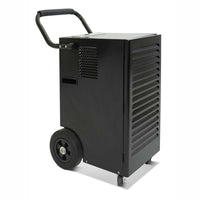
Rated output and real output
Most makers quote litres a day at 30°C and 80% relative humidity (RH), a few at 20°C and 60%, so compare like with like. In those cooler, drier conditions a machine rated at 30°C typically manages around half its figure, and less again on a cold site. As a rough guide, 10 to 30 litres suits a cabin or store room, 40 to 90 litres flood and building drying, and 150 litres and up a warehouse or plant room.
LGR, conventional or desiccant
A conventional compressor machine condenses water on a cold coil and suits a heated building, slowing down and defrosting more as it gets colder. An LGR machine pre-cools the air before the coil, so it keeps extracting in cooler conditions and can take the air drier than a conventional machine. A desiccant machine soaks moisture into a turning wheel and usually ducts it outside as warm, damp air, so it works in unheated stores and below freezing, though it draws more power.
Drainage, power and transport
A tank needs emptying, a gravity hose needs a drain below the machine, and a built-in pump lifts water a few metres to a sink or outside, so it can run unattended. Building sites usually run portable kit at 110 volts through a transformer, so pick a 110 volt or dual voltage model there, and have a qualified electrician connect any 400 volt three phase unit. Rotomoulded and steel cases take knocks, some stack, and the intake filter needs regular cleaning.